Do not use a screenshot as current evidence merely because the UI looks plausible. Capture and publish the screenshot set only after the current live release checkpoint passes. Each image must be tied to the same source commit, organization, receipt, and capture date.
Pre-capture gate
Run this gate before opening the browser or creating data/kubara-gui-evidence/receipt.yaml:
npm run kubara-release:verify-static
npm run kubara-faithful-hub-spoke:verify
npm run kubara-mini-idp:receipt-verify
npm run kubara-mini-idp:performance:receipt-verify
npm run kubara-mini-idp:orphan-audit:receipt-verify
npm run kubara-platform-matrix:verify
npm run kubara-wiring:verify
This gate deliberately does not require screenshots, so it cannot be satisfied by the images it is meant to authorize. It must bind one source commit and one organization to a current faithful receipt, current adapted receipt, the immediate zero-action run, disclosed performance, exact ConfigHub inventory and scoped Argo/workload residue, and the exact matrix and wiring inputs. Today the measured no-op is 33 ConfigHub CLI read commands, 208 total subprocess calls, and about 77 seconds with zero ConfigHub mutation attempts and zero Argo sync requests. It meets the fixture regression target; those commands are not HTTP round trips, and the measurement is not a raw-Kubara comparison, speed claim, or service-level promise.
If any command fails or any input changes after it passes, capture nothing (or discard the uncatalogued capture) and rerun the gate. Only then capture exactly six real frames under docs/images/kubara/, create the GUI receipt with every required hash and caption, embed all six frames atomically, and run npm run kubara-release:verify. Do not add placeholder, mocked, historical, partial, or receipt-free screenshots.
Tour order
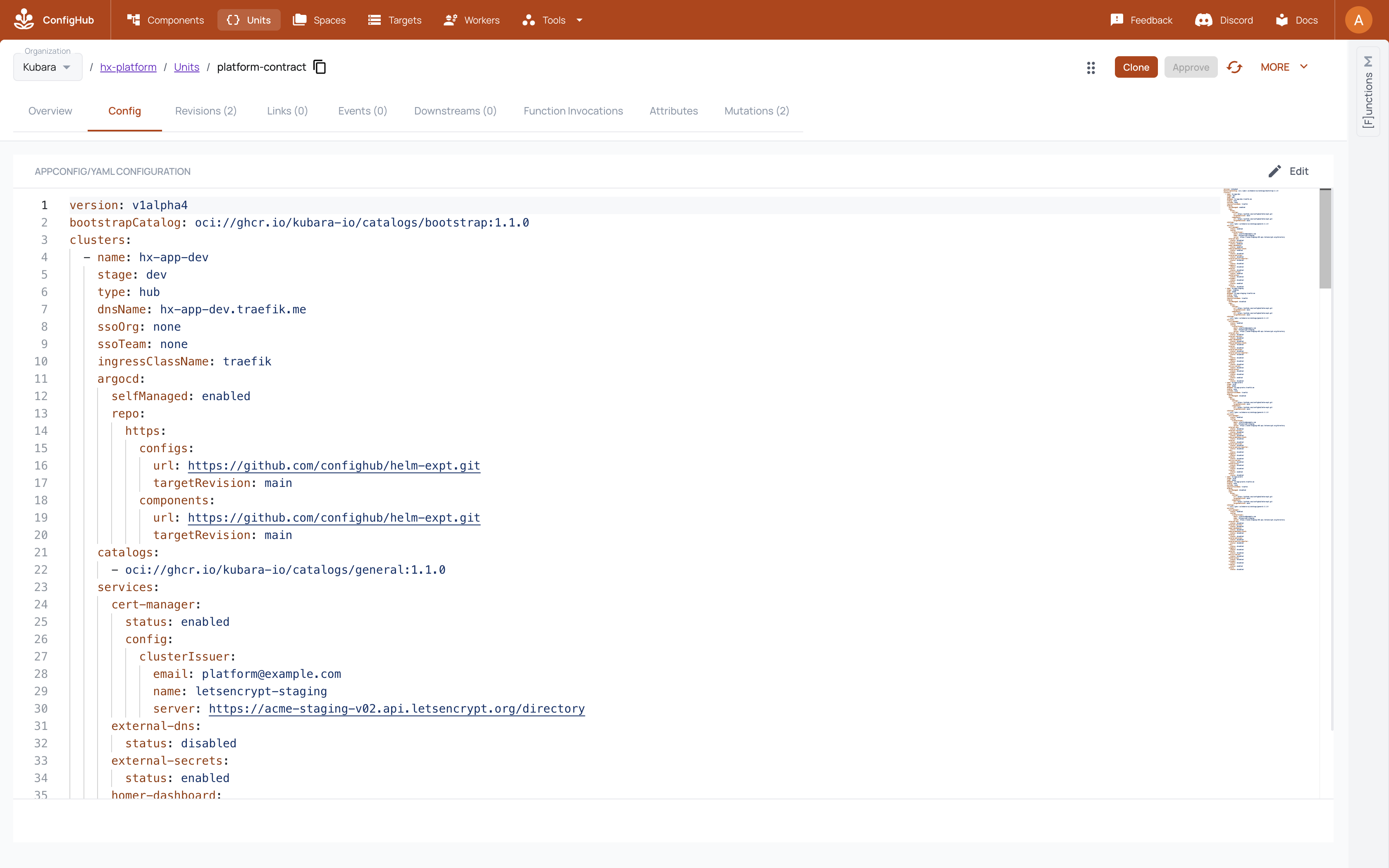
1. Start at the platform contract
Open the Unit labeled StartHere=true and the hx-platform/platform-contract record.
Show:
- Kubara version and exact source Git revision;
- the one-hub/three-spoke platform identity;
- the seven selected platform roles;
- links to the Catalog, matrix, wiring evidence, and both delivery lanes; and
- the exact receipt status behind the tour.
Key takeaway: this is the same Kubara platform, with its source and evidence made navigable.
Screenshot checkpoint: platform contract header, source identity, and navigation labels in one frame.
2. Browse components before platform instances
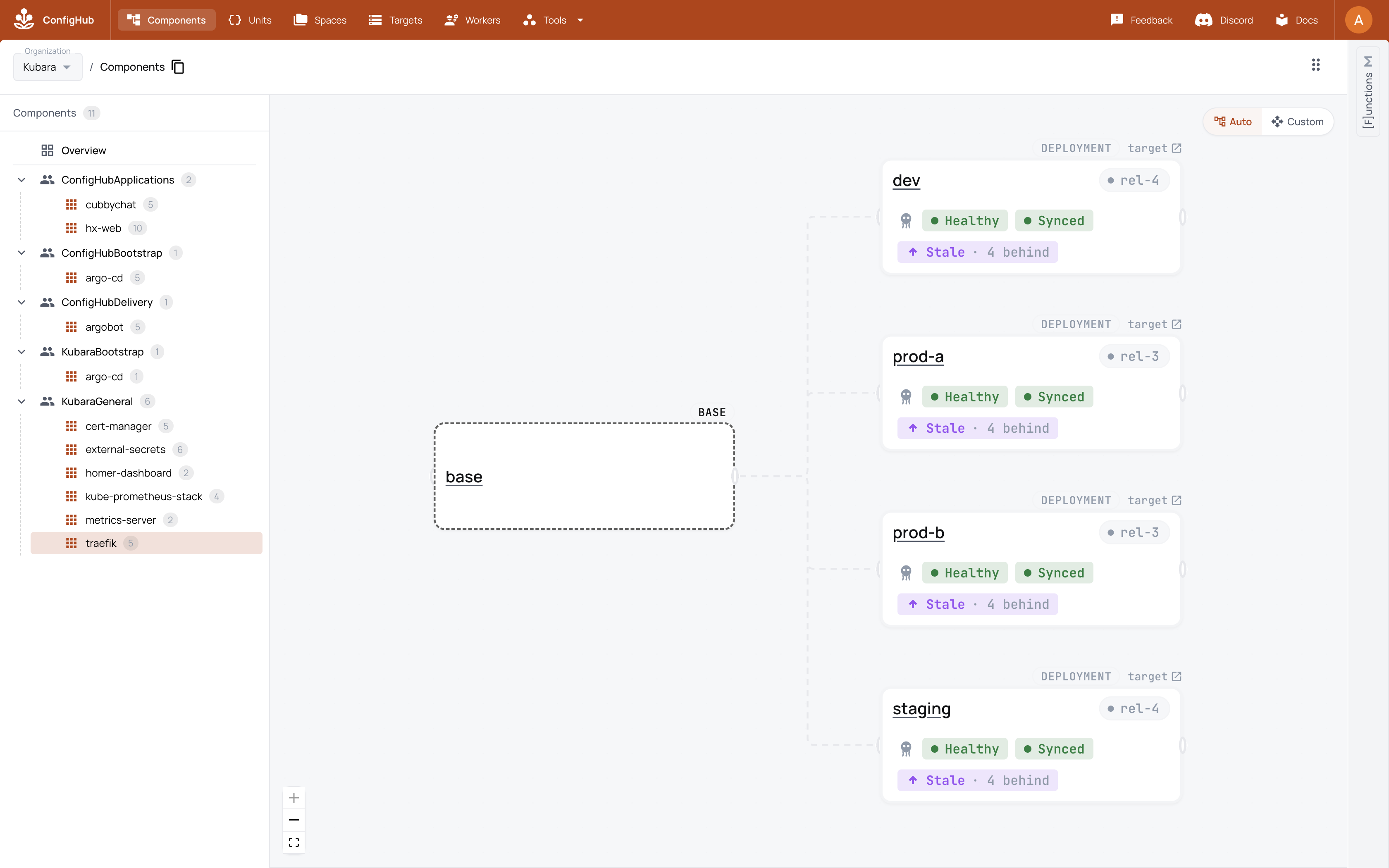
Open the ConfigHub component Catalog before showing target-specific Units.
Show:
- a familiar Kubara-selected component;
- its retained older and newer versions;
- deployable variants and configurations as follow-on views;
- exact chart source and OCI digest metadata; and
- the platform instances that selected that component version.
If an instance card says Stale · N behind, keep it visible and explain the scope: this is ConfigHub's upstream definition/variant departure signal-an available governed update-not evidence that Argo is OutOfSync. The release digest, Argo revision, sync/health, and workload readiness are proved separately in the platform matrix. A deliberately pinned instance can be Synced and Healthy while still showing that newer definition revisions exist.
Key takeaway: Kubara still chooses and wires a platform package; ConfigHub makes each reusable component and every retained version independently governable.
Screenshot checkpoint: one component, its version history, and its instance relationship.
3. Show the recognizable delivery shape
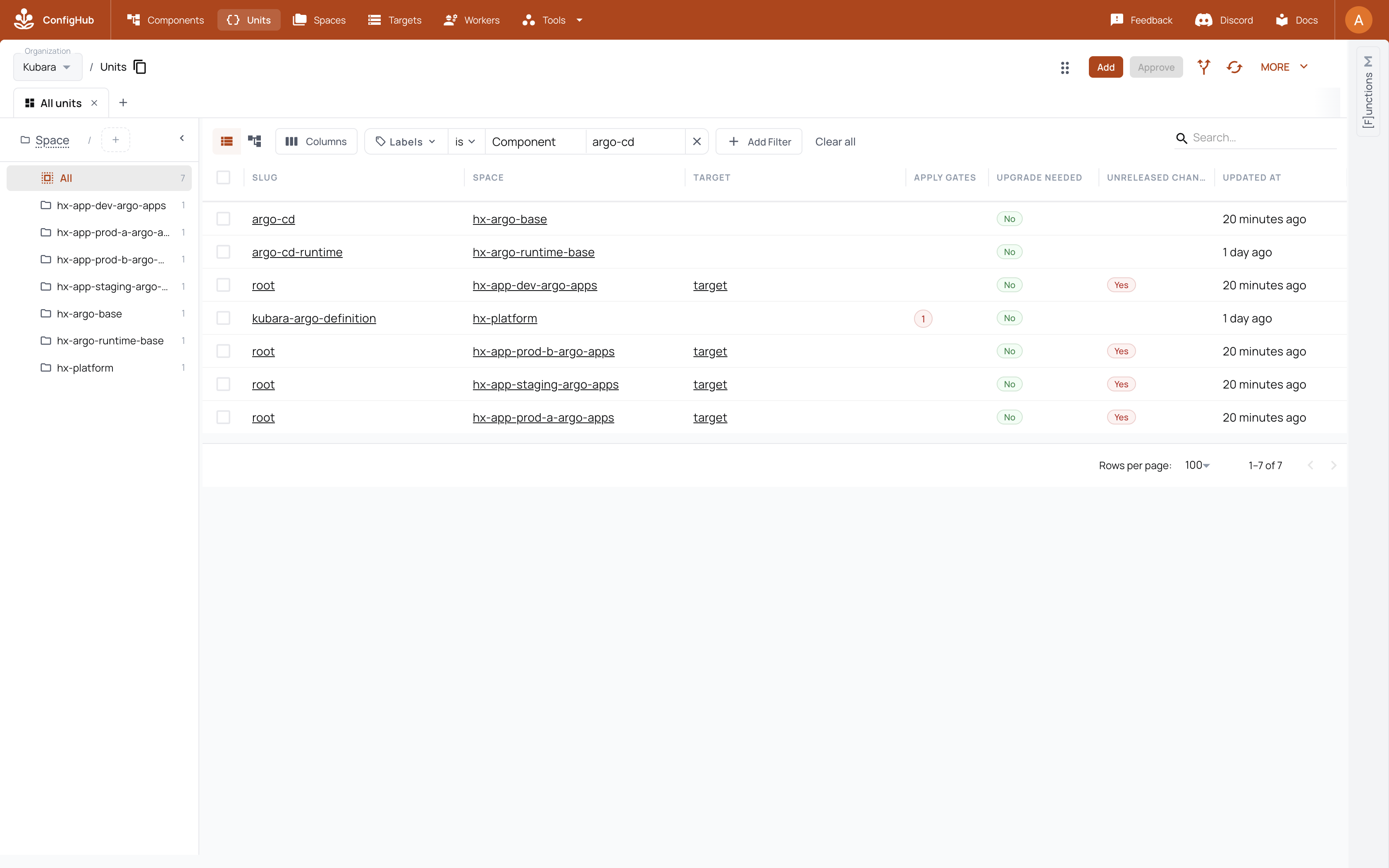
Display the faithful and adapted Argo definitions side by side.
Show:
Lane=Faithful: Kubara's hub Argo, AppProject, ApplicationSets, and spoke registration remain recognizable;Lane=Adapted: ConfigHub takes the governance/hub role while each target keeps its local Argo reconciler; and- the four explicit target clusters and environments;
targetRevision: latestlabelled as discovery-only andspec.syncPolicy.automatedabsent from every managed Application; and- the pinned argobot v0.1.6 refresh-only settings:
ARGO_SYNC_MODE=kubernetes,ARGO_NAMESPACE=argocd, andARGO_REFRESH_TYPE=hard.
Key takeaway: ConfigHub adds a simpler operating lane without declaring the Kubara topology wrong or removing the faithful option. Argo remains local, but a mutable latest pointer cannot bypass ConfigHub governance.
Screenshot checkpoint: both lane cards plus the four target relationships.
4. Follow one application through four clusters
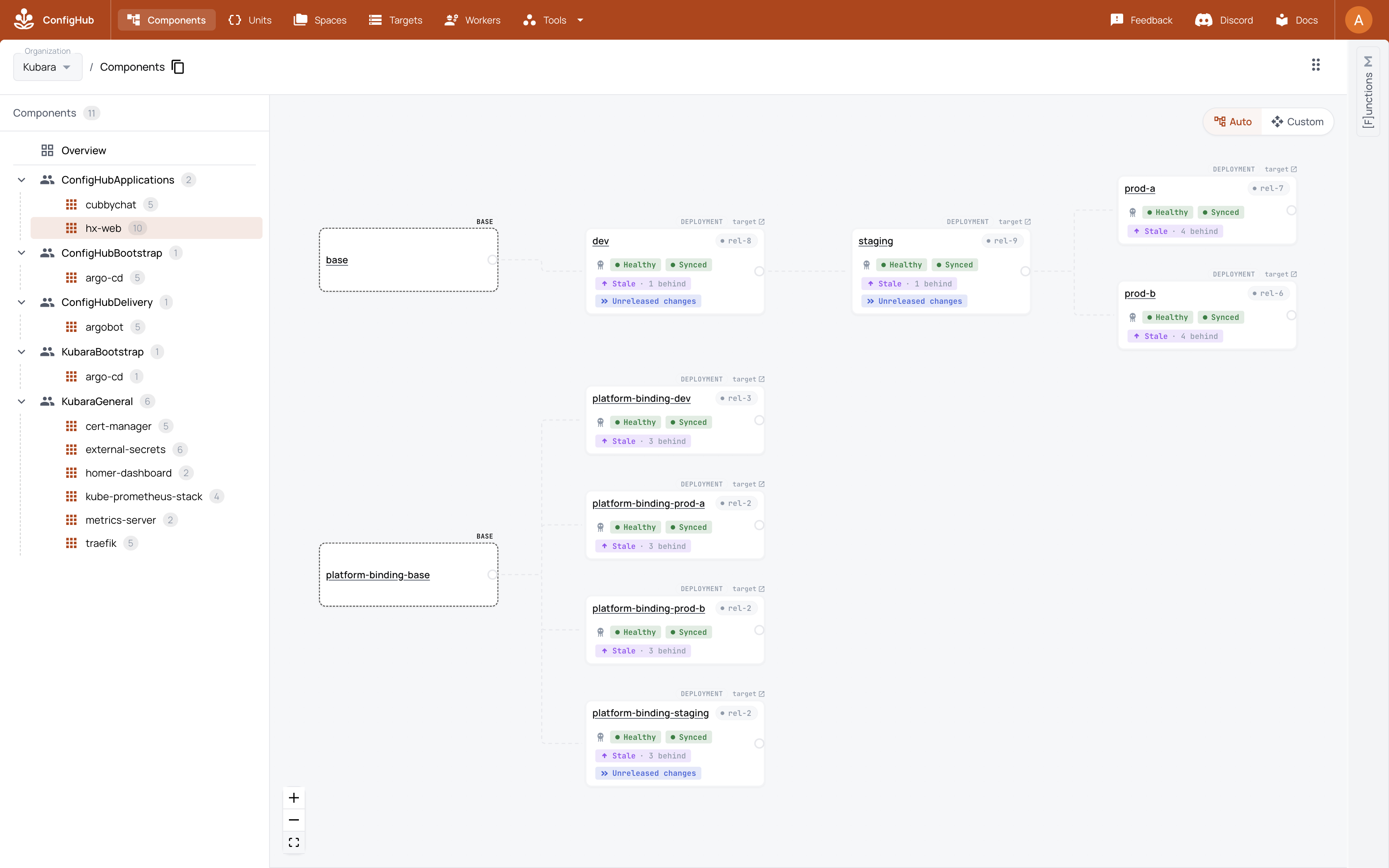
Use hx-web as the short story and Cubbychat as the richer application.
Show:
- development, staging, production A, and production B instances;
- the exact source revision and OCI digest at each target;
- one target-specific departure;
- production approvals performed at server
HeadRevisionNum, bracketed by unchanged Unit ID, observed numeric head, andDataHash; - promotion history;
- an exact rollback on one production target;
- the 16 journaled selector replacements and the four unchanged bound PostgreSQL PVC identities;
- the authoritative ConfigHub
ManifestDigestbeside Argo's observed revision; and - receipt evidence that the reconciler submitted
operation.sync.revision=<ManifestDigest>only after exact release revalidation, no active operation, and Kubernetes UID/resourceVersion compare-and-set.
Key takeaway: the platform definition and the application release are separate, but their target placement and history are visible together; the approved digest, not mutable latest, is what Argo reconciles.
Screenshot checkpoint: one application detail frame with the four target placements and its approval, promotion, departure, and rollback history visible together. This is frame 4 of the six-frame tour, not four additional images.
5. Open the wiring
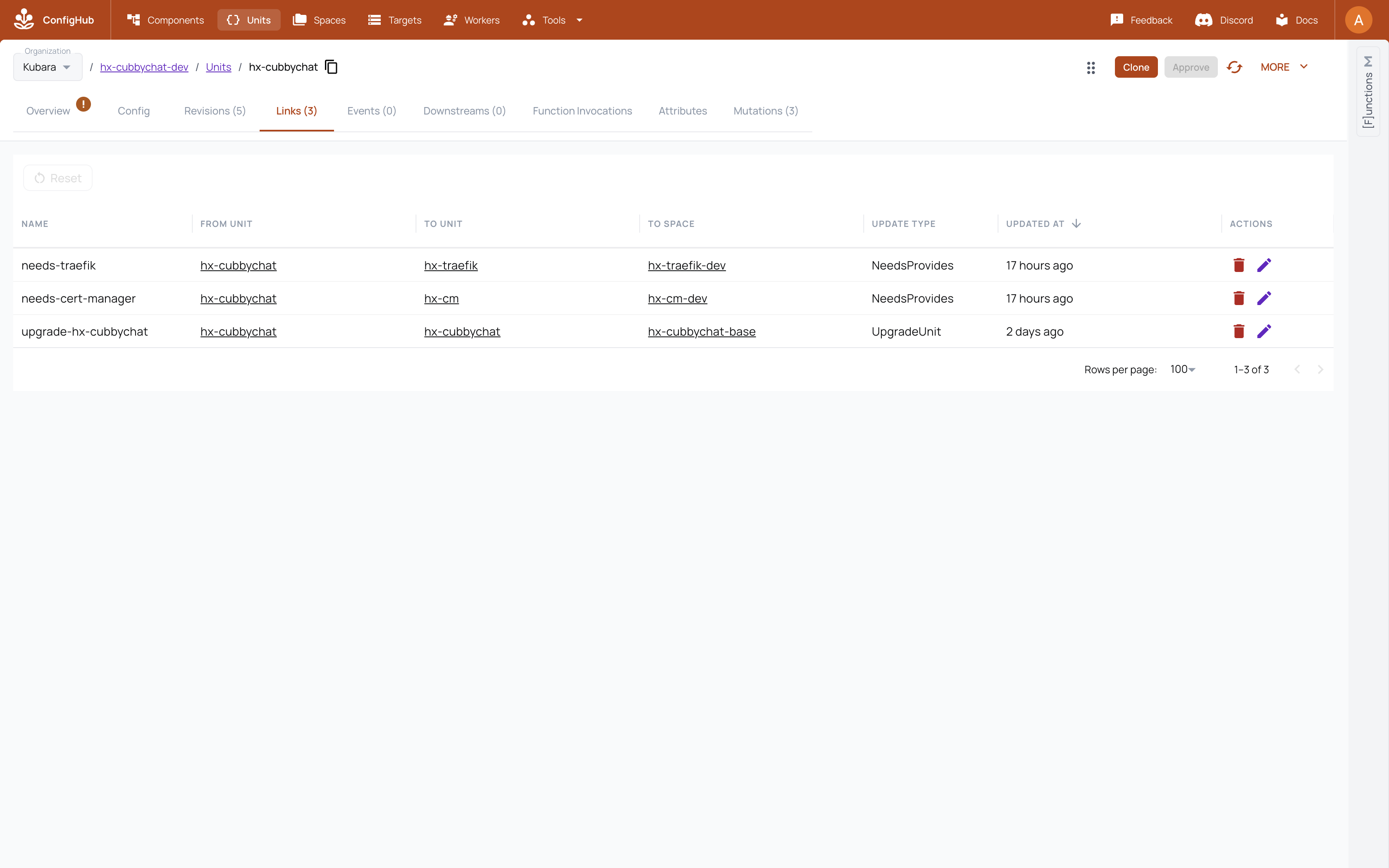
Start with curated native NeedsProvides Links, not the entire extracted graph.
Show relationships such as:
- application Ingress to ingress class;
- application Certificate to ClusterIssuer;
- Grafana Secret to ExternalSecret or SecretStore; and
- component instances to shared platform capabilities.
Then link to the complete generated wiring evidence for engineering review.
Key takeaway: relationships that were implicit in folders and generated YAML can become queryable platform facts.
Screenshot checkpoint: a small, legible set of native Links with both ends visible.
6. Finish with the fleet matrix and clean inventory
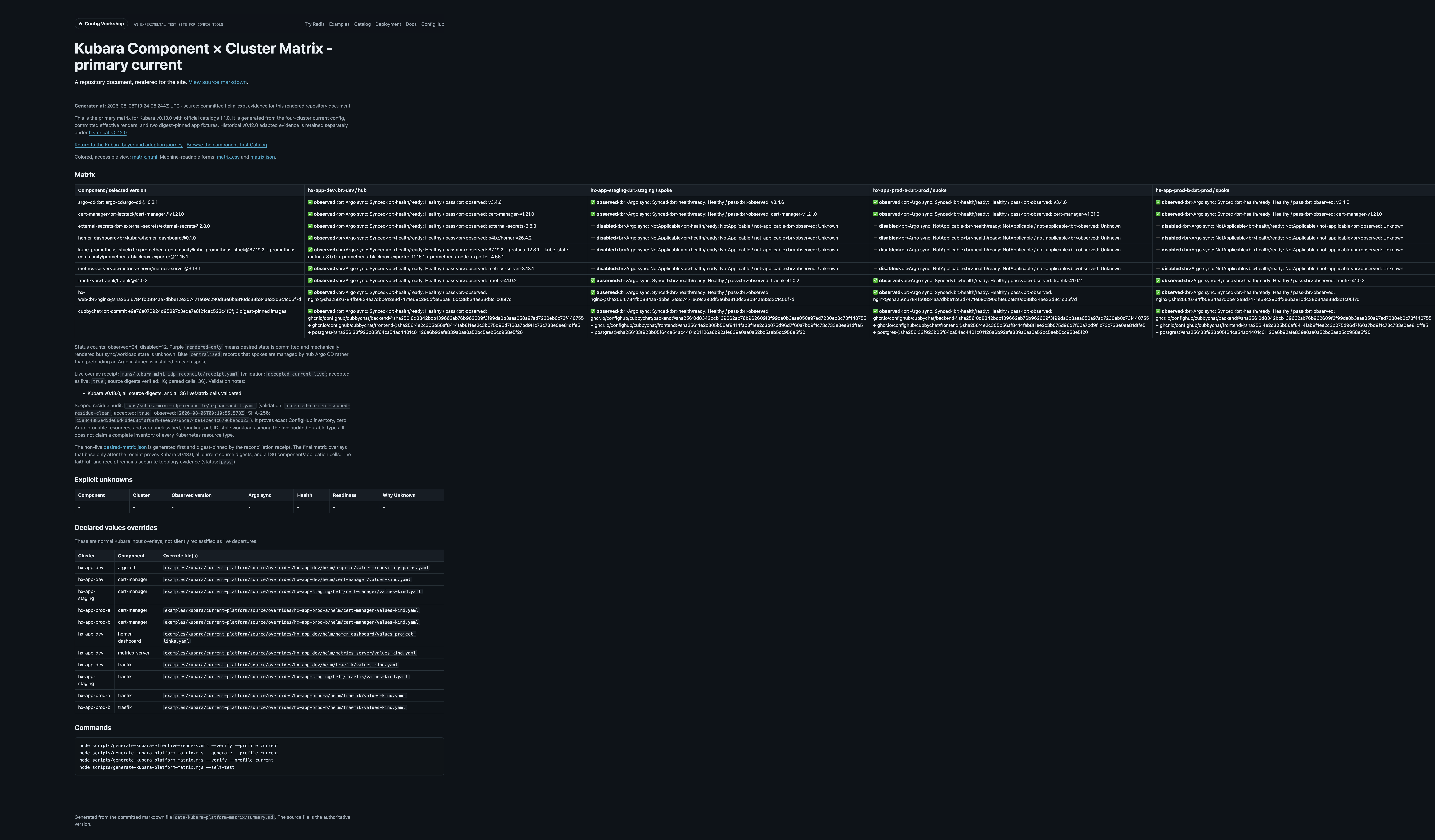
Open the 36-cell component/application-by-cluster matrix and the exact scoped residue-audit result.
Show:
- selected, centralized, and disabled placement;
- desired placement/version/departure separately from the observed ConfigHub release digest;
- Argo's exact observed revision, sync, and health separately from Kubernetes desired/ready workload counts;
- target departures; and
- zero unexpected ConfigHub objects, dangling Links, Argo-prunable resources, or unclassified, dangling, or UID-stale audited durable workloads.
A disabled selection is NotApplicable. A desired cell without an accepted source-current observation is Unknown; the matrix must never turn desired state into inferred runtime health.
Key takeaway: Kubara's platform matrix becomes current data, and the demo organization's governed inventory is proved clean rather than merely looking tidy. The receipt does not claim a complete inventory of every Kubernetes resource type.
Screenshot checkpoint: current matrix plus the scoped residue receipt identity.
Explain, but do not spend the demo running
- the long preparation and release qualification pipeline;
- package media types and every member of the platform digest index;
- content-addressed reconciliation and compare-and-set safety internals;
- target-fact and secret isolation mechanics;
- the entire extracted wiring graph; and
- a long cold import while the buyer waits.
These details remain available in the technical mini-IDP reference, the importer guide, and the reconciliation performance analysis.
Do explain one boundary plainly: the evidence controls the managed automated delivery path. It does not prove that a privileged human cannot issue a manual Argo sync unless separate RBAC or admission evidence is also shown.
Screenshot evidence contract
For every published GUI image, retain alongside the image:
- capture date and UTC time;
- exact source commit;
- ConfigHub organization external and internal IDs;
- Space, Unit, Link, or Component identities visible in the frame;
- exact faithful, mini-IDP, and orphan receipt hashes;
- exact public matrix and full wiring graph hashes;
- the screenshot file's own SHA-256 digest;
- whether sensitive values were absent or redacted; and
- a short caption that states exactly what the image proves and does not prove.
The atomic receipt path is data/kubara-gui-evidence/receipt.yaml. It must record exactly six images and bind sourceCommit, both organization IDs, faithful, mini-IDP, orphan, matrix, and wiring SHA-256 values. Every image record must bind its repository-relative path, SHA-256, exact UTC capture time, visible identities, sensitive-value handling, caption, and claim boundary.
The website generator should refuse to present the screenshot set as current when any source, organization, receipt, artifact, screenshot digest, or capture time no longer matches the accepted evidence chain. The six frames are one atomic evidence set: do not publish a partial tour as current.
Next: use the complete technical reference to reproduce the result.