Goal
Run the normal Kubara generation path, preserve its platform components, platform configurations, add-ons, AppProjects, ApplicationSets, overrides, and cluster wiring, and bind the result to exact, reproducible evidence.
For the current example, the same config is generated twice: once from a pinned snapshot of Kubara's official 1.1.0 catalogs and once from the byte-preserving ConfigHub-aligned export. Both runs must produce exactly the same 135 paths and bytes.
What remains Kubara
- The executable is Kubara v0.13.0.
- Kubara reads its native
config.yaml, catalogs, service definitions, and values configuration. - Kubara's ordinary
generate --helmpath createsplatform-components/andplatform-configs/. - The generated AppProjects and ApplicationSets preserve the recognizable hub and spoke topology.
- A Kubara user can inspect, diff, and operate the generated tree with Kubara's existing documentation and mental model.
ConfigHub does not emulate Kubara generation, infer missing intent, or rewrite the result into a different source model.
What ConfigHub adds
The reproducibility wrapper around generation adds:
- a SHA-pinned Kubara binary and exact Helm build;
- immutable catalog snapshots and a byte-preserving aligned export;
- exact chart archive checksums and the Traefik OCI manifest digest;
- path-and-byte comparison of the two catalog lanes;
- deterministic double rendering for every selected component instance;
- a checksum inventory and machine-readable receipts; and
- checks that reject workstation paths, credential-shaped material, unresolved placeholders, missing repository authorization, and unrecorded overrides.
These are supply-chain and review controls around Kubara's output. The generation receipt explicitly records live reconciliation as unobserved.
Reproduce the current example
Generation is the only online phase in these first two steps. It requires Kubara, Helm, curl, oras, and network access to the exact reviewed artifact locations.
1. Verify the aligned catalog export
cd /absolute/path/to/helm-expt
npm run kubara-catalog-adapter:verify
This must pass before the aligned catalog can participate in the comparison. It proves the export matches the pinned Kubara catalog tree; it does not prove the generated result until the next command succeeds.
2. Install and verify the pinned Kubara binary
Download Kubara v0.13.0 for your platform from the release identified in source-lock.yaml. Verify both the release archive and extracted binary against that lock. For the recorded Darwin arm64 example, the extracted binary SHA-256 is 72642ce49aa5e9d13aeb4441aebc4c4530c7427c0d0aacbcee7b97e249f57183.
export KUBARA_BIN=/absolute/path/to/kubara
"$KUBARA_BIN" --version
shasum -a 256 "$KUBARA_BIN"
The expected version output is kubara version v0.13.0. Use the checksum for your reviewed release asset and platform; never copy the Darwin arm64 checksum onto a different binary.
3. Generate both catalog lanes and all effective renders
npm run kubara-current-example:generateThe generator internally invokes Kubara's familiar command against a clean temporary work directory:
kubara --work-dir <temporary-lane> \
  --config-file config.yaml \
  --env-file .env \
  generate --helm
The temporary .env is generation-only and is never copied to the result. The generator then places the reviewed normal overrides beside Kubara's values.generated.yaml, fetches only the exact locked component archives, and renders each selected instance twice with the same capabilities.
Do not run the illustrative command by hand and expect it to reproduce this repository's evidence: the wrapper also performs the catalog substitution in temporary copies, exact artifact checks, double rendering, and atomic output replacement.
4. Verify without network or clusters
npm run kubara-current-example:verifyVerification does not require Kubara, Helm, registries, chart repositories, a ConfigHub organization, or a Kubernetes cluster. It recomputes the source, generated-tree, render, and receipt checks from committed bytes.
Expected artifacts
After a successful current-example generation, review:
examples/kubara/current-platform/
  generated/
    platform-components/
    platform-configs/
  effective-renders/<cluster>/<service>/release-objects.yaml
  source-checksums.txt
  generated-checksums.txt
  effective-render-checksums.txt
  catalog-parity-receipt.yaml
  generation-receipt.yaml
The expected current counts are:
- 135 files in
generated/; - 13
release-objects.yamleffective renders; - two catalog lanes with no path or byte differences;
- four clusters; and
- seven exact external artifact locks, plus the retained first-party Kubara wrappers.
The effective renders are desired-state evidence. They are not evidence that Argo CD applied the objects or that the workloads became healthy.
Machine checkpoint
Run the verifier, then independently count the two principal output sets:
npm run kubara-current-example:verify

test "$(find examples/kubara/current-platform/generated -type f | wc -l | tr -d ' ')" = 135
test "$(find examples/kubara/current-platform/effective-renders \
  -name release-objects.yaml -type f | wc -l | tr -d ' ')" = 13
The verifier's final line must be:
verified Kubara v0.13.0 current platform offline: 2 catalog lanes, 4 clusters, 7 exact artifacts, 13 deterministic rendersThen inspect catalog-parity-receipt.yaml. Its status.result must be pass, comparison.mode must be path-and-byte-for-byte, fileCount must be 135, and differences must be an empty list.
That is the evidence for “adopt without a rewrite.” It does not establish live ConfigHub, Argo, or Kubernetes health; those checkpoints occur in Steps 5 and 6.
Screenshot checkpoint
Do not substitute a diagram or mocked terminal for the machine result. This chapter owns exactly one future adoption frame, separate from the ConfigHub GUI tour.
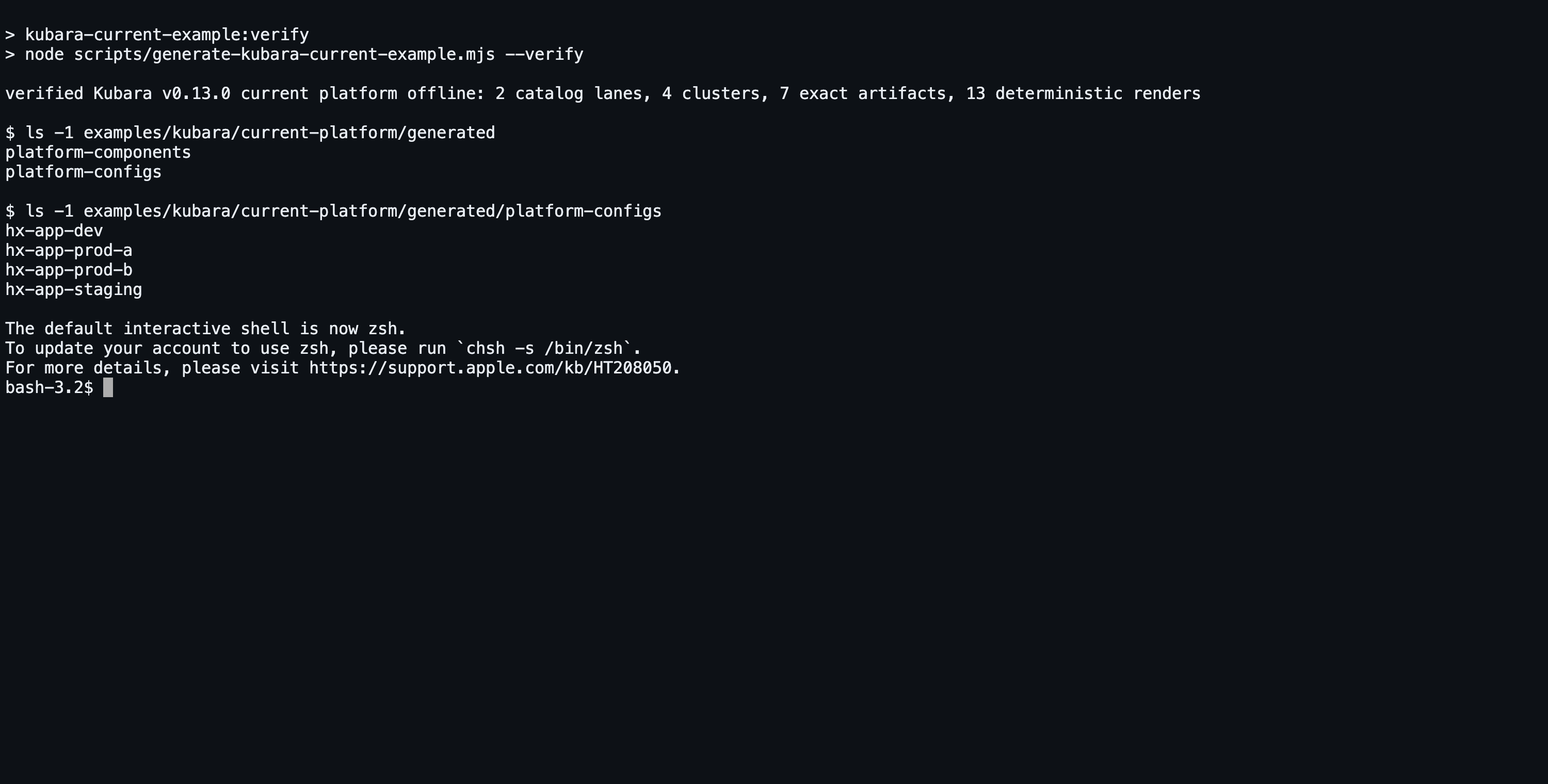
After the checkpoint and complete source-current live gate pass, capture one real terminal/repository frame containing the complete verifier final line and the adjacent generated tree with platform-components/, platform-configs/, and the four cluster directories visible. This may be a single real browser or terminal workspace view; do not assemble unrelated runs into a synthetic image.
The caption should say: “Kubara's official catalog and the ConfigHub-aligned export generated 135 path-and-byte-identical files.” Include the commit ID in the surrounding page text, not as an unverifiable graphic annotation. A live ConfigHub or cluster screenshot does not belong at this step. Embed the image at the declared path only when the six-frame adoption receipt binds its digest and UTC capture time to the same source commit and Git trees, generation and catalog-parity receipts, visible identities, sensitive-value handling, caption, and claim boundary. Until then, leave the hook unexpanded.
Troubleshooting
The Kubara binary version or SHA differs
Stop and resolve the source lock. Do not regenerate receipts with an unreviewed binary. If intentionally upgrading Kubara, review and update the source lock, regenerate both lanes, and treat any output difference as a real platform change.
An exact chart is unavailable from a mutable Helm index
Use the exact reviewed release URL or OCI reference recorded in component-artifacts.yaml, and verify its checksum or manifest digest. Never silently select the nearest version. Add the newly obtained artifact to the Catalog without removing older retained versions.
The two catalog lanes differ
Inspect Catalog.yaml, services/, platform-components/, and platform-configs/ in the aligned export. A ConfigHub component mapping may add metadata outside that export, but the compatibility export must preserve Kubara's full package. Do not waive a byte difference.
Rendering is nondeterministic
Find the time-, randomness-, network-, or environment-dependent template input and make it explicit. Do not keep the first render and discard the second.
A rendered result contains a credential or workstation path
Move secrets and target-local facts out of the portable platform tree. Replace imperative local changes with reviewed values-*.yaml overrides where the setting is genuinely part of desired configuration.
Only the raw Kubara tree exists
That is still a valid Kubara result, but it is not yet the complete ConfigHub handoff. Generate the exact locks, deterministic renders, checksums, and receipts before continuing.
Safe to stop here
Yes. A passing generated tree is a complete Kubara result and deterministic evidence, but it has not yet crossed the Git, OCI, ConfigHub, or live-cluster boundaries. Preserve the source locks and receipts with the output.
Continue
← Step 1: choose components and wiring · Step 3: commit and push the complete hand-off →